Projects
I love working on and building projects! Here are some my favorites below, including research I have worked on and am currently working on, along with some personal projects. Super excited about the node perturbation research I'm working on right now :) And would love to discuss more!
Research
Diffusion models like ControlNet let you steer image generation with structured inputs such as segmentation maps, but they quietly assume those inputs are clean and accurate. Real annotations rarely are! I studied what happens when they aren't, and whether the model can be taught to notice.
I corrupted ADE20K segmentation maps with three kinds of realistic annotation noise (boundary perturbation, region dropout, and label flipping) across four intensity levels, then measured how generation quality degraded using CLIP similarity and a boundary alignment score. Semantic corruption turned out to be the real threat: label flipping cut CLIP similarity by up to 32%, while the diffusion backbone shrugged off geometric boundary noise almost entirely. I also found a structural alignment paradox, where the baseline's alignment score rises under noise because the model is faithfully reproducing corrupted structure.
To address this, I introduced a lightweight, non-learned reliability estimator that scores conditioning quality from edge density and fragmentation, then uses that score to adaptively scale ControlNet's conditioning strength at inference time. It improved CLIP similarity by 18.0% under 50% label-flip noise with no retraining or architectural changes, showing that even simple input-quality awareness can make conditional generation meaningfully more robust.
I conducted this research as my final project for the Intro to Computer Vision course at MIT (6.s058) Spring 2026.
Personal Projects
EPA Natural Language Query System
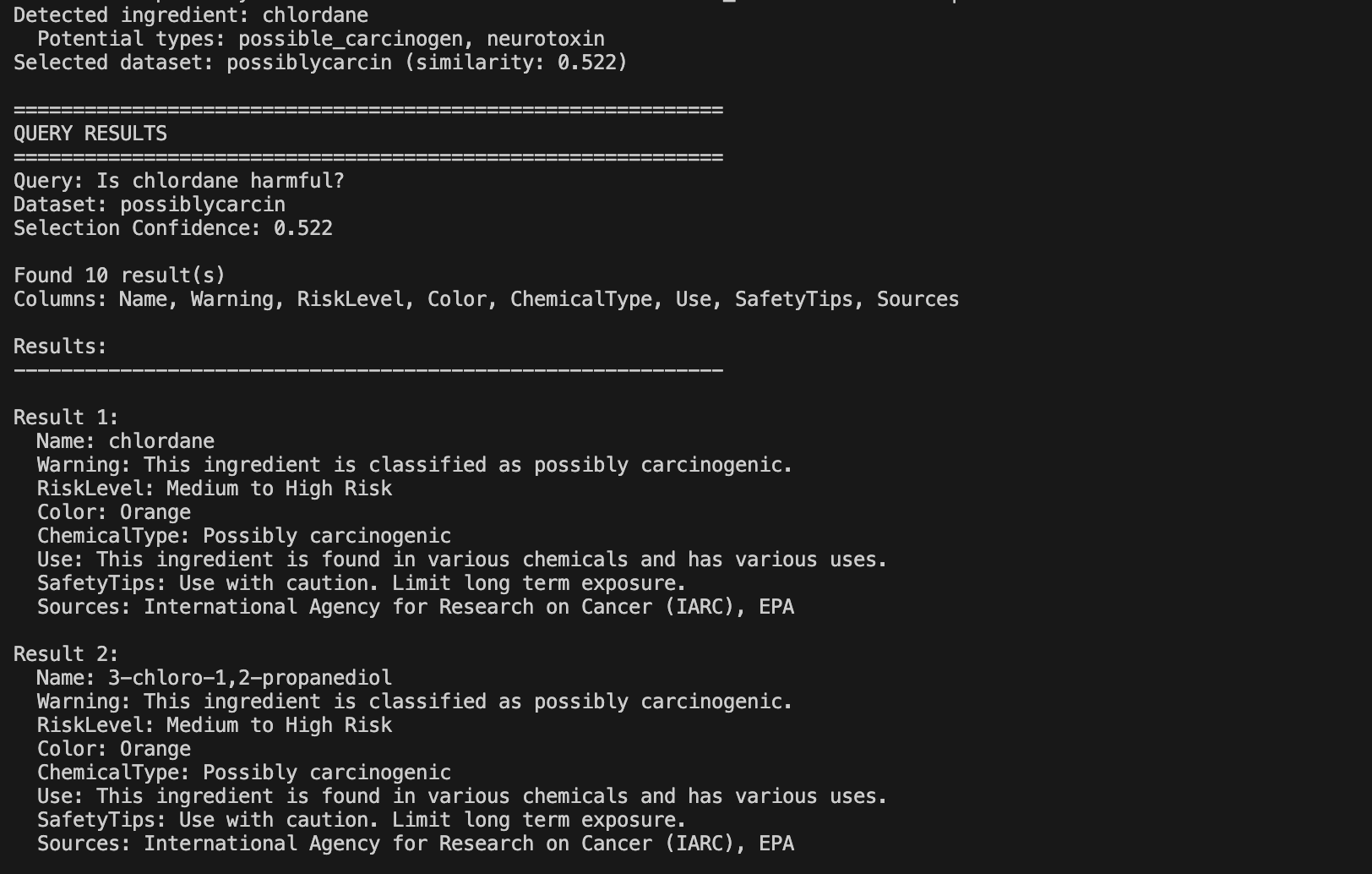
A natural language query system for EPA (Environmental Protection Agency) datasets. This system allows you to query multiple JSON datasets using natural language, using a context layer and embeddings to select the most relevant dataset and extracting the requested ingredient information from the relevant dataset.
RevealTheIngredient: A Computer-Vision Based iOS Application

A computer vision iOS application with the ability to scan and recognize over 25,000 ingredients found in chemical products.
User-Friendly Defective Solar Cell Detection using Artificial Intelligence

Created web application to recognize defects in 1,000+ solar cells in real-time, preventing solar panel degradation.
And some links to some other projects here...